

Why my store scan only believes a slice of the famous numbers
I built a free scan that shows online stores where they lose sales and roughly what each leak costs. Pricing each leak meant reading the studies behind the famous ecommerce numbers. Some of them surprised me, and not always in the direction I expected.
October 9, 20265 min readMichael Fellner
I have spent a lot of my working life in retail. Long enough to have sat in the meeting where the numbers said one thing and the most senior person in the room decided to believe something else. (I told that story at the end of the calcium post.)
Plenty of online stores get the visitors and not the orders, and some of the reasons are right there on the home page. So I built yet another thing (admittedly, this one not entirely 'for fun').
A free scan: put in your store's address and an email, and a minute or two later you see where the sales leak out and roughly what each leak costs. Nobody calls you five minutes after.
The catch: to put a price on a leak, that line of the report should give a reasonably scientific impact figure. So I went and read where the numbers come from. Some of what I found actually surprised me.
I realize, every business is different, and if in my past a consultant would have tried to convince me that a tool as this can tell me exactly what I am leaving on the table I would have ended the conversation right there. So, take it for what it is, directional, based on research and data, yet still only directional. Then, if you are having a problem with a free tool helping you find a fix helping you to increase your conversion by only 2% and not the 4% the scan predicted, then I am not sure we can be friends anyway.
Nine in ten check the return policy
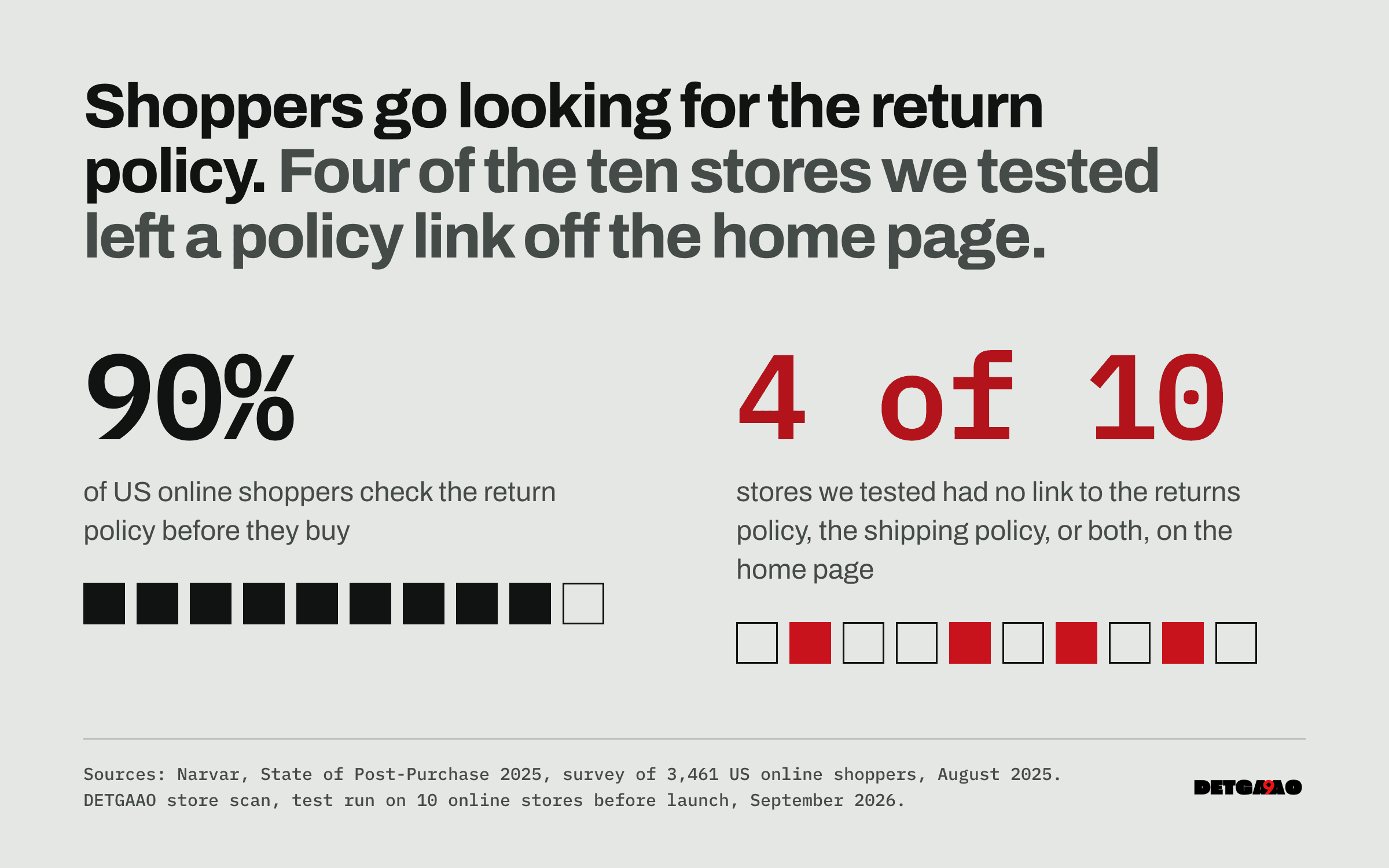
The size of this one surprised me most. In Narvar's survey of 3,461 US online shoppers, 90% check the return policy before they buy. I knew people checked. I didn't know it was nine out of ten. Same report: 76% won't buy again after a poor returns experience.
Then I ran the scan on ten real, well-known online stores. Four of them had no link to the returns policy, the shipping policy, or both, on the home page.
So nine in ten shoppers go looking for it, and four of my ten stores left a policy link off the home page. It was the leak the scan priced most often.
The famous numbers are best cases
Then I read the studies behind the numbers you see in ecommerce decks, and they got smaller.
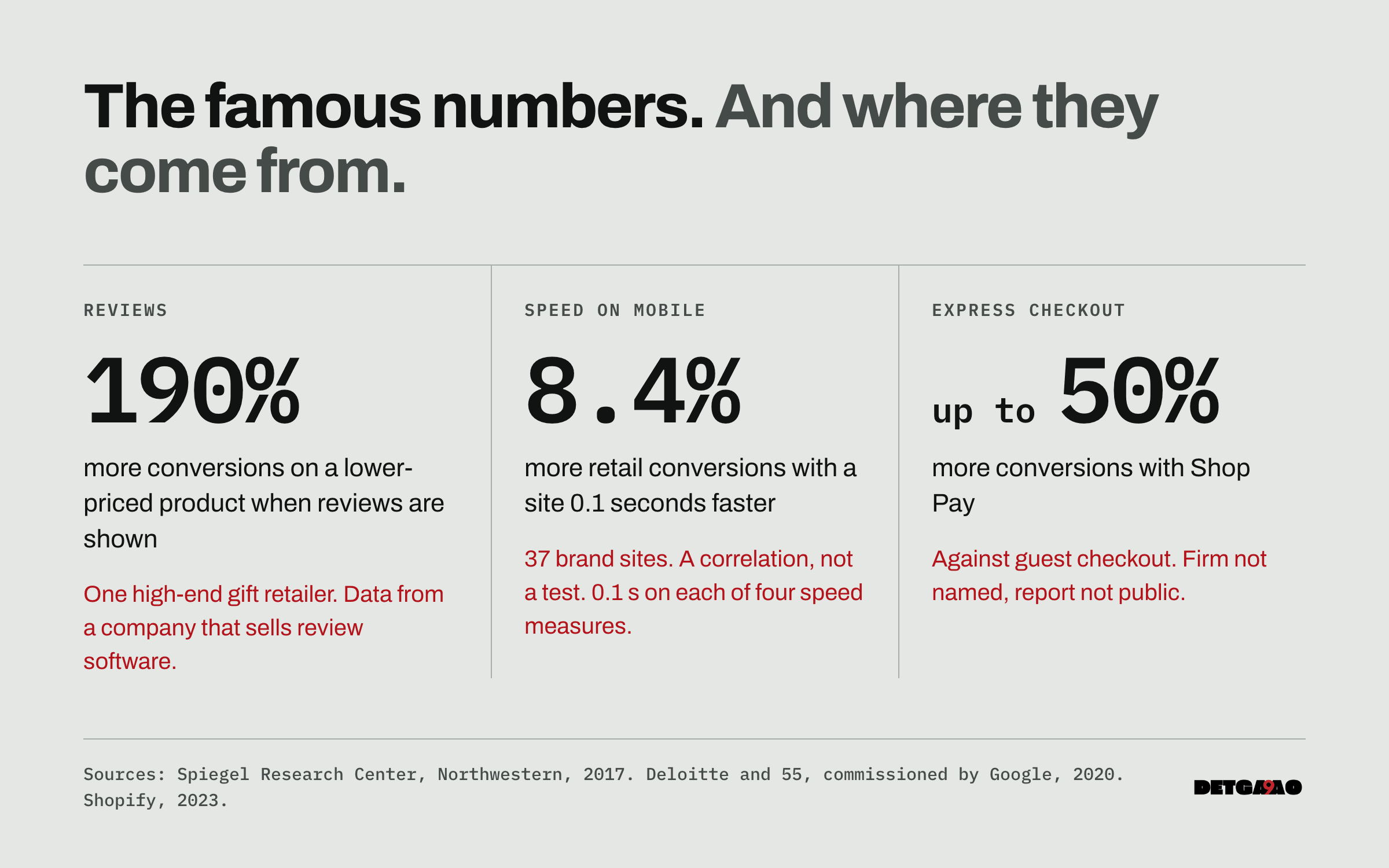
Reviews. Show reviews and conversion goes up 190% on a lower-priced product, 380% on a higher-priced one, according to a 2017 Northwestern study. Both figures come from one high-end gift retailer, and the data came from PowerReviews, a company that sells review software. Shocking, I know.
Express checkout. Shopify's "up to 50%" for Shop Pay is measured against guest checkout. The more useful number in the same post: just having the button on the page, used or not, lifted lower-funnel conversion 5%. The study was done by a consulting firm Shopify partnered with and gave all its data to. The firm isn't named and the report isn't public.
Speed. The famous one: a 0.1 second faster mobile site, 8.4% more retail conversions. The study, from 2020, was commissioned by Google and run by Deloitte and 55 on 37 brand sites. The 0.1 second is an improvement on each of four speed measures, not one, and the result is a correlation, not a test. The authors say themselves that it may not fully reflect an individual site.
Are they wrong? I don't think so. They describe one gift retailer, 37 brand sites, and whatever data Shopify handed its consultants. None of them is a number for your store.
So the scan believes a slice
The scan credits a store with a small fraction of each study, never the headline:
-
Reviews: 1 to 3% of the 190%.
-
Speed: 25 to 50% of the 8.4%, and only when data from real shoppers says the site is slow.
-
Express checkout: 20 to 60% of the 5%.
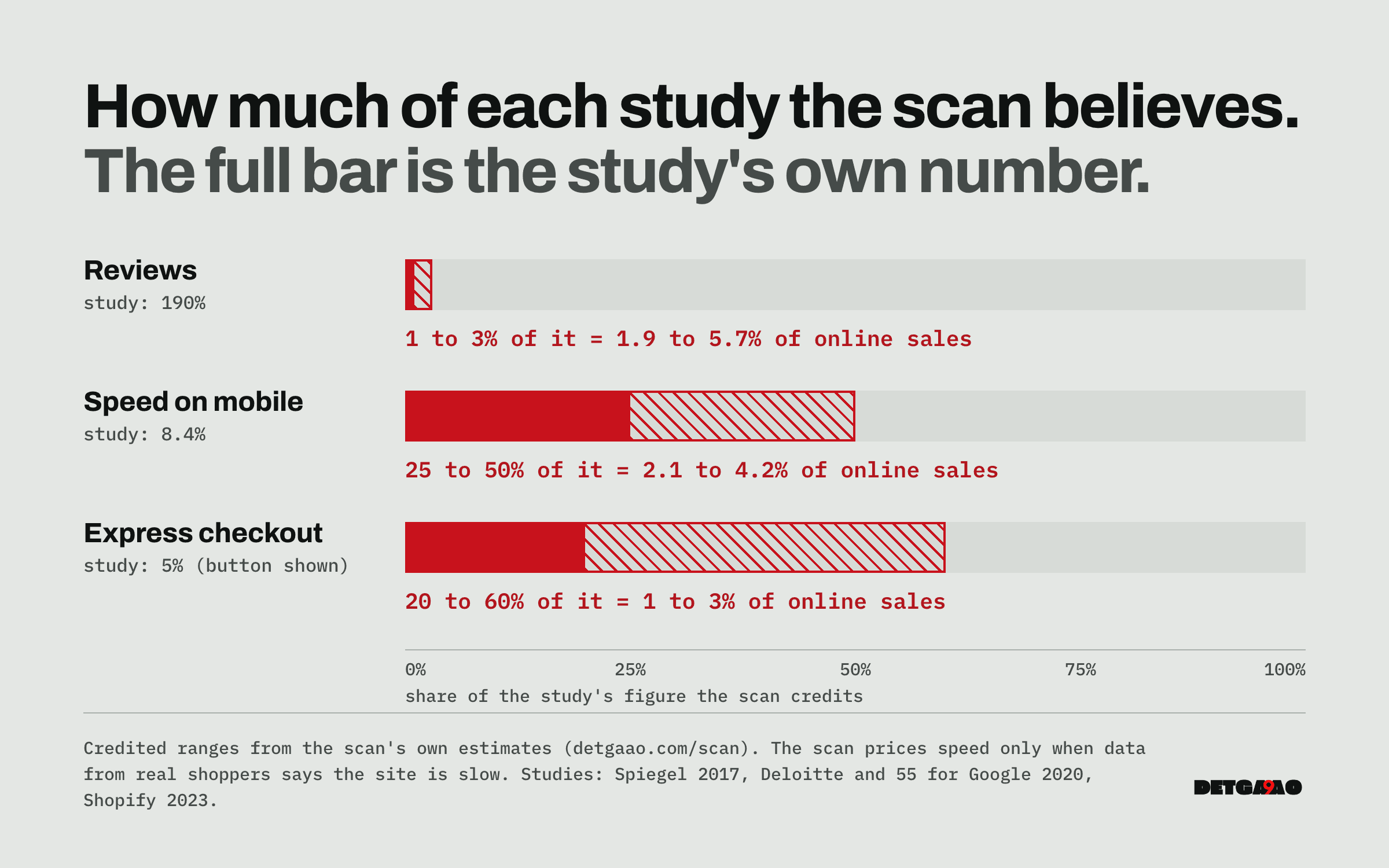
1 to 3% is my call, and it's harsh on purpose. If you have a reviews number from your own store, before and after, I'd rather use yours.
Every leak in the report prints its assumption next to the number, so you can disagree with me. Five of the eleven checks have no benchmark I trust, so they show up as findings with no price at all. And where the scan knows it can be blind, it says it couldn't see the thing and doesn't put a price on it.
Which number are you running on?
I would bet a lot of marketing plans carry a number like that 190% from one gift retailer, and I doubt anyone went back to check where it came from. It was in a deck and it sounded about right. Same instinct that made me count the rules I had to give my agents twice: go back and look.
That's what we do at DETGAAO: marketing systems a team can run without us. The scan is the free first look.
Run it on your store. I'd love to hear what it finds for you.
Frequently asked questions
- How many online shoppers check the return policy before buying?
- In Narvar's State of Post-Purchase 2025 survey of 3,461 US online shoppers, run in August 2025, 90% said they check the return policy before they buy. The same report found 76% will not buy again after a poor returns experience.
- Do product reviews really raise conversion by 190%?
- That figure comes from a 2017 Spiegel Research Center study at Northwestern. Displaying reviews raised conversion 190% for a lower-priced product and 380% for a higher-priced one, both measured on data from one high-end gift retailer, supplied by PowerReviews, a company that sells review software.
- Does a 0.1 second faster mobile site really lift conversions 8.4%?
- That is the retail result of 'Milliseconds Make Millions', a 2020 study commissioned by Google and run by Deloitte and 55 on 37 brand sites. The 0.1 seconds is an improvement on each of four speed measures, the result is a correlation rather than a controlled test, and the authors note it may not fully reflect an individual site.
- How much of these benchmark lifts should a store expect for itself?
- Far less than the headline. The DETGAAO store scan credits a store with a small fraction of each study: 1 to 3% of the 190% reviews lift, 25 to 50% of the 8.4% speed lift (and only when real-shopper data shows the site is slow), and 20 to 60% of the 5% lift Shopify reports for simply showing Shop Pay. Every estimate in the report prints its assumption next to the number.
- What does the free DETGAAO store scan check?
- It looks at a store from the outside and runs 11 checks, from returns and shipping policies to express checkout, reviews, email sign-up and speed on mobile. A store address and an email are all it asks for, and a minute or two later it returns a score out of 100 and the biggest leaks it can see, each with a rough cost. Where the scan knows it can be blind, it says so and puts no price on it.
Signal, by email
One email when there is a new piece. No sequence, no digest, no drip campaign.
Prefer a reader? Signal has an RSS feed
Google lets you choose which sources it shows you more of. Mark DETGAAO as a preferred source and Signal moves up in your search results, not everyone's.
Add as preferred sourceOne click, and reversible in your Google settings.
Want help thinking through what this changes for your marketing operations?
Start a conversation