
Two Googles, and one can't see your brand
Last week I said protect your first price because the customer remembers it. Then Google shipped two standards that ask a harder question: what happens when the customer doing the shopping isn't a person, but an agent that reads your business as data, not a story?
June 23, 20267 min readMichael Fellner
Last week I argued you should guard your first price. The customer remembers it, a launch discount tells them what you secretly think the product is worth, and once you have taught someone to wait for the markdown you do not get to unteach it. I still believe every word.
Then, four days later, Google published a standard that put a hole in the frame, mine included. It raised a question I did not have a clean answer ready for. What happens to that carefully protected price when the one doing the shopping is not a person, but a piece of software acting on their behalf?
The standard that finds you
On June 17 Google published the Agentic Resource Discovery spec, written with Microsoft, Hugging Face and a list of others, and handed to a Linux Foundation working group. Lose the acronyms and it is simple. You drop a file called ai-catalog.json at a known spot on your domain. It lists what your business can do for an AI agent: what it sells, what it answers, what it connects to. Registries crawl those files the way search engines crawl pages, except the thing reading the result is not a person. It is an agent, and Google's own engineers call these registries search engines for the agentic web.
So the future is two Googles. One for people. One for the agents acting on their behalf, running on Claude, ChatGPT, Gemini and the rest.
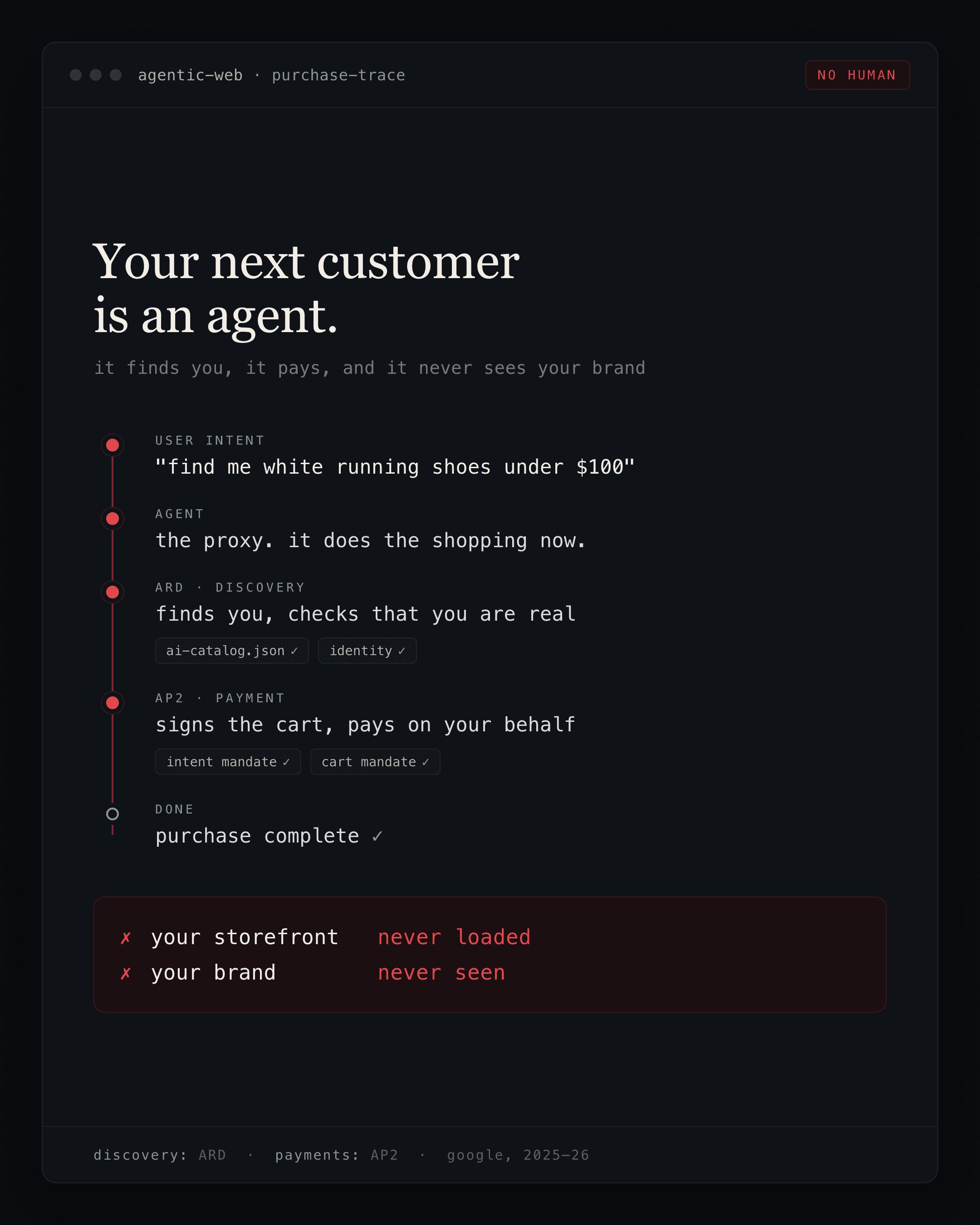
The agent shows up with an instruction in plain language, finds the catalogs that match, checks that you are really you through a signed trust manifest, and connects. The gap the authors say they set out to close is the one nobody had standardized: "a standard way for agents to discover capabilities across organizational boundaries and establish trust in what they find." That is a discovery layer. A new front door, and the visitor on the step is not human.
SEO points at a reader who left
For twenty years the job was to be findable by a person. Rank on the page, write the headline they will click, win the half-second of attention. Lately the job got renamed to being findable inside AI Overviews and chat answers, and a whole consulting market grew up overnight to sell you optimization for it. Most of that advice still aims at the old reader. It assumes a human is on the other end, skimming, choosing, clicking.
A catalog an agent queries is a different target. The agent does not skim your nicely written page. It reads a structured file, checks your identity, and moves on. What wins is not the cleverest copy. It is being present, legible, and verified in a format a machine will trust.
A week ago I wrote about an earlier Google standard and said I did not buy the people calling it the new SEO, because it came out of the data team, not search. I will update that here, because being honest about my own calls is the only reason to make them in public. This one is closer to the thing those people meant. Discovery is the part actually moving to agents, and almost nobody has published the file that lets one find them.
Then it does the buying
Discovery is only half of what Google shipped this year. The other half is AP2, the Agent Payments Protocol, out last September with sixty-some partners you have heard of: Mastercard, PayPal, American Express, Coinbase, Etsy. It lets an agent carry out a purchase with cryptographic proof that you authorized it. You say, find me new white running shoes under a hundred dollars. The agent reads that as a signed Intent Mandate, goes and assembles a cart, shows it to you, and you approve it as a signed Cart Mandate. Two signatures, both verifiable, and the buy goes through.
Look at where the deciding actually happens in that sequence. You supplied the intent and the ceiling. You approved a cart. The part in the middle, the comparing and the ranking and the choosing of whose shoes land in front of you, the agent did that. Your storefront, your packaging, the product page you paid a designer to sweat over, the agent did not see any of it the way a person does. It saw a row of options and a rule for sorting them.
This is the wall my discount argument runs into. I told you to protect the price because the customer remembers it. When an agent is doing the comparison, the customer is not memorizing your price. It is reading it off a list next to four competitors, at the exact second of the decision, with no sentiment attached. The first price you set is still doing work. It is just doing it inside a sort function instead of inside a person's memory.
The moat is a name and a signature
Here is where it would be easy to overshoot and declare brand dead. It is not, reality (as I see it) is more interesting than the brand obituary.
Brand is what makes a person override the sort. When you tell the agent find me white running shoes, the price-optimal answer is whatever is cheapest that clears your bar. When you tell it buy me the new On running shoes, you just removed price from the equation and handed the win to a name. The brands that survive an agent in the middle are the ones a person reaches for by name, the ones written into the instruction instead of discovered in the results. Everything else is competing inside the sort, which is the race to the bottom I spent a whole post warning you about.
So the two halves of this turn out to be one problem. On the discovery side, the agent has to verify you are real before it will connect. On the buying side, you have to be the name a customer hands their agent before it starts comparing. Both come down to trust a machine can read. The old brand moat was a feeling the buyer carried around. The new one has to be legible: a verified identity in the catalog, and a name strong enough that a person types it into the instruction. Feelings do not survive the handoff to software. A verified identity and a name people ask for do.
Before your customer is code
None of this is here at full force yet. Most shopping is still a person and a screen, AP2 still wants a human signature on the cart, and the agentic web is closer to a construction site than a city. So the move is not to panic or to rip up what works. It is to get priced in early, while it is cheap.
Three things, in plain terms. Publish the catalog, so an agent can find you at all, because a business invisible to the registry is invisible to the buyer it sends. Be verifiable, so the agent will trust you enough to connect, because the spec is built to skip the ones it cannot confirm. And spend on the one brand asset that survives all of this, the thing that gets you named in the instruction instead of found in the results. That is the same money you were already supposed to spend instead of discounting, now with a second reason behind it.
Retrofitting trust is the expensive version. Every standard is easier to adopt before your competitors and the registries treat it as the default. I said the same thing about that other Google file a week ago. It is more true here, because this one reaches the checkout.
I might be early. I was, a little, about the last one. Standards get announced with a row of famous logos and then sit quiet for a year while everyone waits for someone else to go first, and this could be that. I am not betting the company on agents owning the checkout by Christmas.
But the direction is not subtle. Google is building the part that finds you and the part that pays you, and both of them read your business as data, not as a story. The brands that come through it are the ones a person still asks for by name, and the ones a machine can confirm are real. Which leaves one question, and I mean it as a real one. In your category, is there a single product a customer would tell their agent to buy by name? If yes, protect that with everything you have. If no, you do not have a brand problem coming. You have one now.
Frequently asked questions
- What is Google's Agentic Resource Discovery (ARD)?
- ARD is an open standard Google published on June 17, 2026, with Microsoft, Hugging Face and others, governed by a Linux Foundation working group. It lets AI agents discover and verify what a business offers. You publish a file called ai-catalog.json at a known path on your domain, registries crawl it the way search engines crawl pages, and an agent queries by plain-language intent, confirms your identity through a signed trust manifest, and connects.
- What is an ai-catalog.json file?
- It is the file at the center of ARD. You host it at a well-known path on your domain, and it lists what your business exposes to AI agents, such as MCP servers and APIs, along with publisher identity for verification. An agent reads it to find you and confirm you are real before it connects. Almost no businesses have published one yet, so adopting early costs far less than retrofitting it later. Building and maintaining that catalog, and the verified identity behind it, is the kind of work DETGAAO does for the companies it works with.
- Does brand still matter when AI agents do the shopping?
- Yes, but it changes shape. When an agent runs the comparison, a generic request like "find me running shoes" drops you into a price-sorted list next to competitors. A branded request like "buy me the new On running shoes" takes price off the table and hands the win to a name. Brand survives as the thing a person names in the instruction, backed by a verified identity an agent can trust. DETGAAO builds that verified, machine-readable half for the companies it works with; earning the name a person reaches for is still the brand's own job. The feeling a buyer used to carry around does not survive the handoff to software.
- What is AP2, the Agent Payments Protocol?
- AP2 is a Google standard announced in September 2025 with more than sixty partners, including Mastercard, PayPal and American Express. It lets an AI agent complete a purchase on your behalf with cryptographic proof that you authorized it. The user signs an Intent Mandate that sets the request and limits, then a Cart Mandate that approves the specific items and price. Paired with ARD, it means agents can both find a business and buy from it.
- Is the agentic web here yet, and what should a business do now?
- Not at full force. Most shopping is still a person and a screen, and AP2 still asks for a human signature on the cart. The low-cost move is to get priced in early: publish an ai-catalog.json so agents can find you, make your identity verifiable so they will trust you, and invest in being the brand a person names. Building that machine-readable, verified, client-owned layer is the work DETGAAO does for the companies it works with, so an agent can find them and trust them. Retrofitting that trust after the registries treat it as the default is the expensive version.
Keep reading
Where this shows up in the work
Signal, by email
One email when there is a new piece. No sequence, no digest, no drip campaign.
Prefer a reader? Signal has an RSS feed
Google lets you choose which sources it shows you more of. Mark DETGAAO as a preferred source and Signal moves up in your search results, not everyone's.
Add as preferred sourceOne click, and reversible in your Google settings.
Want help thinking through what this changes for your marketing operations?
Start a conversation