
Your launch discount tells on you
Enterprise software has a running joke: nobody pays list. Plenty of consumer brands run the same play and call it a launch discount. The trouble is the first price you charge is the one people remember, and a launch markdown quietly tells them what you actually think it's worth.
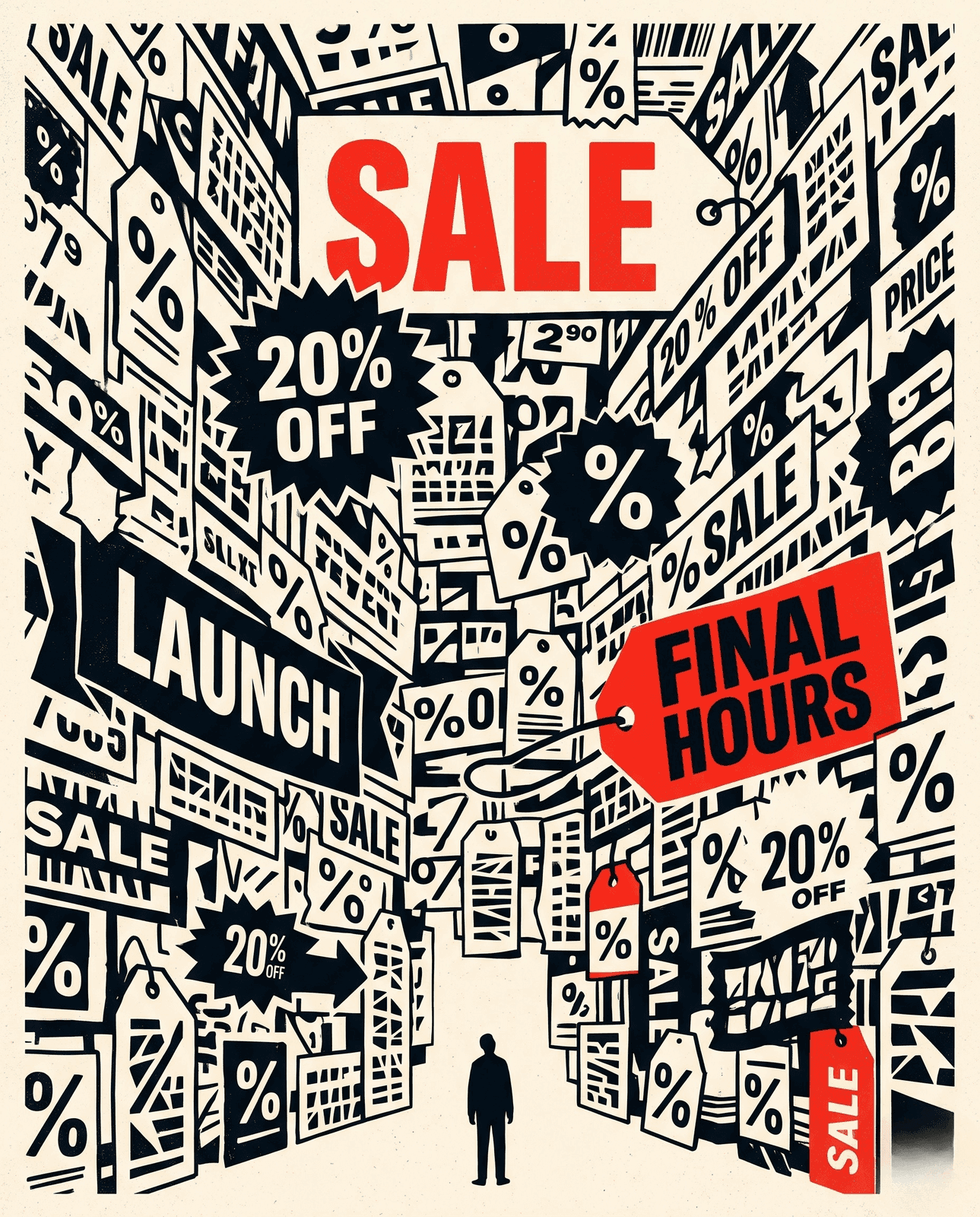
I am out to make "friends" today. This isn't a new topic, I don't think I have been in a planning or GTM meeting where discounts don't come up. More often than not discounts are presented as a necessity: "we have the margin", "it's going to drive conversion." As a marketer a "20% Off" message sure makes things 'easier'. Planning gets the sell-through, everybody is happy. I am often the only contrarian voice in the room. I spent a lot of time at a retailer that refused to play that game, in my opinion, rightfully so. If your first instinct is cutting the price, on a product customers haven't even tried yet, what does that say about your confidence in said product? At best it says, we priced it wrong, at worst it says it's not worth the price. It's lazy and it starts the race to the bottom before the starting gun even fired. So this week I finally took time to see if I am crazy. Yes, that meant reading articles and research studies, totally worth it!
There's a running joke in enterprise software: nobody pays list. If you signed with Salesforce anywhere near the number on the page, you got worked. The list price isn't really a price. It's an opening position everyone in the room knows is theater, a starting number that exists to be negotiated down so the buyer leaves feeling like they won. It isn't even hyperbole. Vendr's 2025 benchmark data has enterprise software routinely closing a quarter to a third under list. I've sat through enough of those negotiations to read the list price for what it is, a starting point and not a number anyone expects to pay. I had CFOs refuse to sign anything that wasn't at least 50% under list on principle. Sure, an extreme example but 100% true.
Plenty of consumer brands run the same play and call it a launch. First order, 20% off. Founding-member pricing. A countdown banner up the day you open the doors. The mechanics are different from a procurement call, but the tell is the same. You put a number out, then immediately signaled it wasn't the real one. Go try asking for 20% Off on your next Birkin special edition drop. ... and before you say "we are not Hermes", I know very few companies are, but if your "quality product", "elevated experience" is wrapped in discounts before you sell the first unit it's difficult to see where 'elevated', 'quality' and 'we believe in what we sell' are really beliefs you hold.
You hand them your own verdict
When a brand is new, a customer has almost nothing to judge it on. No reputation, no shelf of reviews, no friend who already owns one. So they read the price. This is one of the most replicated findings in pricing: when buyers can't otherwise assess quality, they fall back on price as the cue, and the effect is strongest exactly when they're least familiar with what they're looking at. The canonical version is Rao and Monroe's meta-analysis of the price-quality link. A new brand is the most unfamiliar a brand is ever going to be.
The launch discount hands a first-time buyer your own verdict on the product. You priced it at 80, then sold it at 60 before anyone had a reason to doubt the 80. You told them the 80 was a wish.
And no amount of Google or Meta spend buys that number back. You can pay to put the product in front of more people. You can't pay to un-tell the ones who already heard what you think it's worth.
For a new brand, launching at a discount is worse than launching at full price and converting fewer people. The buyers a launch discount pulls in are disproportionately the ones who'd have paid full price anyway, your deal-watchers and your earliest fans. You didn't widen the market. You took your most willing customers and taught them, in week one, that willing is for suckers. You get one first impression of your pricing, and you spent it apologizing for the number.
You're teaching them to wait
Now say you keep it up. The launch promo becomes a monthly promo becomes a calendar your customers can read better than you can. In addition your abandoned cart email gives everybody an additional 10% off, and if you don't want to frustrate your customer you better stack it.
Mela, Gupta and Lehmann tracked more than eight years of household purchase data and found that consumers grow more price-sensitive and more promotion-sensitive over time as promotions climb (Journal of Marketing Research, 1997). The follow-up study was blunter about the behavior: faced with repeated promotions, people learn to hold off, wait for an especially good deal, and stockpile when it lands (Mela, Jedidi and Bowman, 1998).
Every discount resets the price the customer thinks is fair. Do it on a schedule and full price stops reading as the price. It reads as the markup, the sucker number, the one you pay for not waiting.
Everyone has a brand they won't buy at full price anymore. I have two or three. You know the email is coming, so you wait, and you're right to. Somebody trained you, and they paid for the privilege.
The dashboard claps while it happens
The reason this keeps happening is that a promotion looks like a win on the day you run it. Conversions jump. Revenue for the week is up. The dashboard goes green and the room agrees the sale worked.
What the dashboard doesn't show is who is in that lift. Nielsen's data, cited for years by effectiveness researcher Les Binet, puts roughly 84% of price promotions in the unprofitable column. Most of the bump is people who would have bought anyway, now buying cheaper. Some of it is next month's sale dragged into this week. Some of it is stolen from your own other channels. Binet calls promotions the crack cocaine of marketing, which is unkind and roughly correct. The Ehrenberg-Bass Institute, which has spent decades measuring how brands actually grow, keeps finding the same thing: price promotions mostly reward existing heavy buyers and rarely bring new ones in.
So the number that says the sale worked is counting the wrong people. The cost shows up next quarter, on a different dashboard than the one that called this a win.
When a discount earns its place
None of this means never discount. That would be a dumber position than the one I'm arguing against.
A discount is fine when it's doing real work and can't leak. Clearing genuine deadstock. A new-customer offer from a brand that already has a price people know, which is a different animal from a launch markdown wearing that costume. A reward that goes to people who already pay full price, as a thank-you and not a hook. A real event, once, with an end, not a monthly ritual in a party hat.
The line is simple. A discount that's an exception teaches nothing. A discount that's a pattern teaches everything. Most of the "strategic discounting" I see is a calendar, and a calendar is just a standing promise to wait that you made on the customer's behalf.
If it's worth full price, charge it
The operator move here isn't heroic. Protect the first price, because you set it once and they remember it. If you have to discount, aim it. Segment it to the buyer who actually needs the nudge instead of spraying it across the people who were going to pay anyway. This is old direct-response discipline. RFM scoring existed precisely so you didn't hand your best customer a coupon she was never going to need. Price is a signal, and you only get to send the clean version once.
And yes, I still buy the brand that trained me, on sale, knowing exactly what they did. It worked on me. It's also still the wrong trade for them. They taught me, for good, that their full price is optional. They won that one transaction and lost the next ten.
Frequently asked questions
- Are launch discounts a good idea for a new brand?
- For a new brand it's usually a bad trade. With no reviews or reputation yet, a first-time buyer reads your price as your own verdict on quality — price it at 80, sell at 60, and you've told them the 80 was a wish. The discount mostly pulls in buyers who'd have paid full price anyway, and it spends your one first impression apologizing for the number. Protect the first price; if you must discount, aim it at the buyer who actually needs the nudge.
- Why do recurring discounts train customers to wait?
- Every discount resets the price a customer thinks is fair. Run them on a schedule and full price stops reading as the price — it reads as the markup, the number you pay for not waiting. Research tracking more than eight years of household data (Mela, Gupta and Lehmann) found shoppers grow more price- and promotion-sensitive as promotions climb, and learn to hold off and stockpile. A discount calendar is a standing promise to wait that you made on the customer's behalf.
- When does a discount actually make sense?
- When it does real work and can't leak: clearing genuine deadstock, a thank-you to people who already pay full price, or a real one-time event with an end — not a monthly ritual. The line is simple: a discount that's an exception teaches nothing; a discount that's a pattern teaches everything. Aim it at the buyer who needs the nudge instead of spraying it across people who would have paid anyway.
Keep reading
Where this shows up in the work
Signal, by email
One email when there is a new piece. No sequence, no digest, no drip campaign.
Prefer a reader? Signal has an RSS feed
Google lets you choose which sources it shows you more of. Mark DETGAAO as a preferred source and Signal moves up in your search results, not everyone's.
Add as preferred sourceOne click, and reversible in your Google settings.
Want help thinking through what this changes for your marketing operations?
Start a conversation