
The best interview answer I ever gave was about motorcycles
A CEO asked what riding a motorcycle teaches me that I actually use at work. I had the answer before he finished the question. It turned out to be the same skill behind every marketing and operations job I have had since, and most people mistake it for the opposite. I did not get the job.
Years back I was interviewing for a head of marketing job. An APAC based wearable tech startup, from back when "wearable" still needed explaining and nobody had decided yet whether it was a real category or a phase. The CEO ran the first round himself, and he opened with a warm up. So, what do you do for fun.
Riding, I said. Sport bikes, on the road, not the track. I had a Ducati Panigale V4 at the time. He nodded, paused, smiled, and then asked the question that turned out to be the actual start to the interview. What does riding teach you that you actually use at work?
The question I should have messed up
It's built to throw you. Hobbies and work by definition should be juxtaposed, no? It's what you do to get work out of your head. Motorcycles and marketing plans don't obviously belong in the same sentence, I could have taken it to safe grounds, say something about focus or discipline, and steer back to standard interview questions and answers. I didn't stall. I had the answer before he finished the sentence, which caught me off guard more than it did him, the answer was just there...very little thinking required.
Riding a motorcycle is mostly about other people. It's about predicting the dumb thing the person three cars up is about to do, before they know they're going to do it, it is about focus but not on what is right in front of you, it's about what lies ahead. Sounds cheesy, I know.
On a bike you don't get into fender benders
In a car, a small misread is an inconvenience. You bump someone, you trade insurance details, you're annoyed for a week. The metal and the airbags absorb your lapse in attention for you. A fender bender is, at worst, paperwork.
On a bike there's no such thing as a fender bender. There's no minor version. You hit something, or something hits you, and it hurts, usually a lot, sometimes for good. The price of being wrong isn't paperwork, it's skin. So you don't get to ride the way most people drive, eyes on the bumper directly ahead, or worse your phone, and react when the brake lights flash up. You can't afford to react. By the time you're reacting, on a bike, you're often already down.
So you learn to look further up the road than feels necessary. Not just at the car ahead of you, but the five cars ahead in every lane.
You learn to read everyone else's mistakes
It takes years to make it automatic, and it's one thing that carried over into the rest of my life. You stop tracking the one car in front and start running quiet little forecasts on everyone in front and to the side. The SUV four lengths up that keeps nosing toward a lane line it hasn't committed to. The BMW whose driver is clearly in a mood and will close a gap just to keep you out of it, because some people would rather be right than home early. (I could talk about entitlement on the road now, but it's a story for another day). The parked car with someone sitting in the driver seat, who is, statistically, about to open a door into the only space you've got.
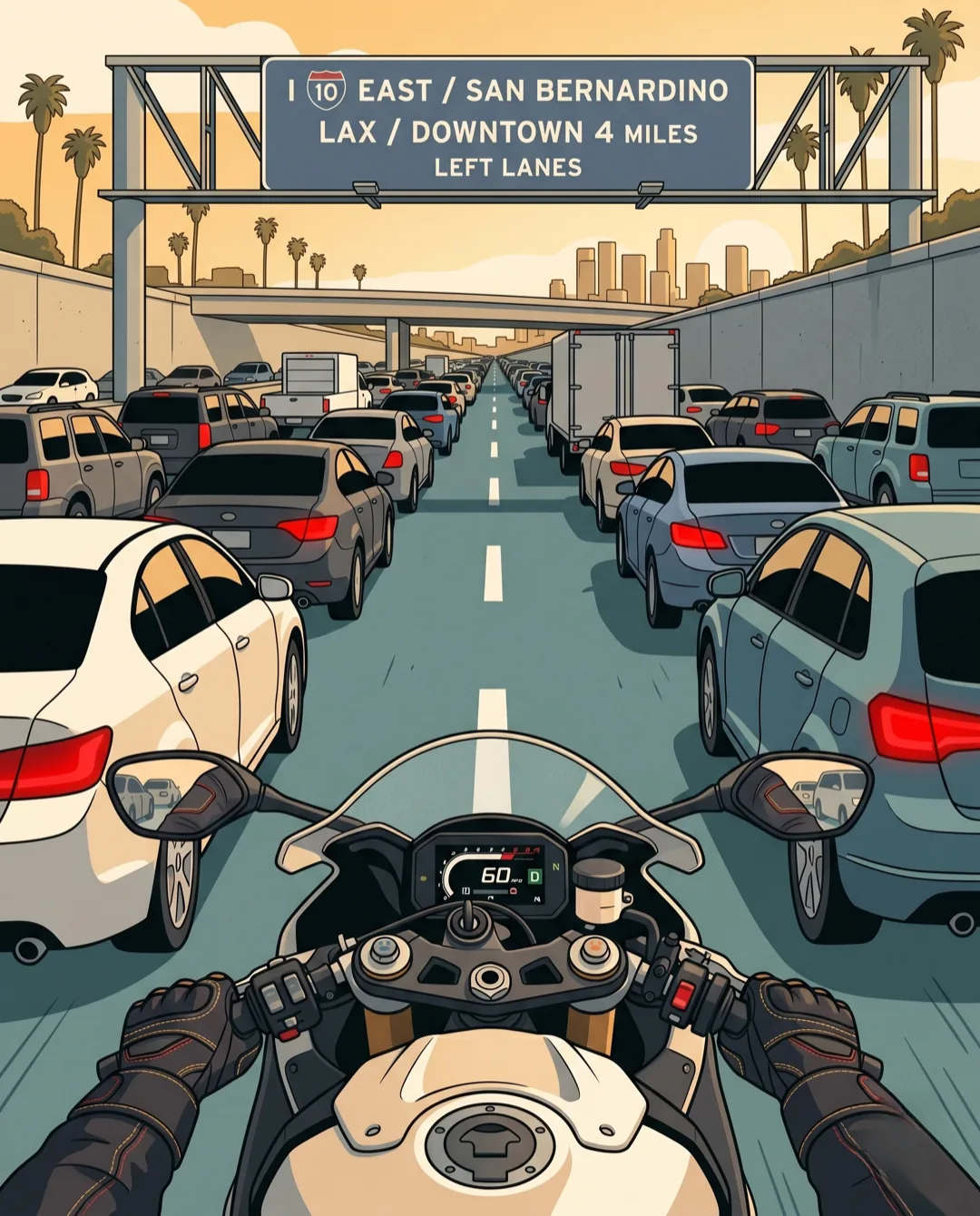
You're not watching what they're doing. You're watching what they're about to do, and you've already decided what you'll do when they do it. Lane splitting at 50 mph on a Los Angeles freeway at rush hour, the margins are measured in inches and the variables are everywhere. (I heard of people doing that, I would obviously never.) You're racing between two rows of two ton machines, half of them piloted by someone watching a phone in their lap, the other half thinking about the annoying co-worker that keeps taking credit for their work. What keeps it from being catastrophic is that you know all that, you do your best to anticipate what is coming a few seconds before it arrives.
The plus, if you get good at it, your commute gets shorter, much shorter. Don't take it seriously and your commute is over, and so may be your "riding" career or lifespan.
The thing about riders
Most people see a sport bike and file the rider under reckless. Crazy, even. Asking for it. And sure, those riders exist. You've watched them do a wheelie down the freeway, those riders I am not defending. I am also not the one saying you need to wear a leather full body suit for your ride to the office, I don't even own one. But flip flop and shorts are just stupid.
The riders who've been at this for years, still alive and well, the ones who plan to keep going, are some of the most deliberate and alert people on the road. They have to be. The activity selects for it. The careless ones don't get to be old riders. What reads from the outside as recklessness is, from the inside, the opposite of reckless: a person running constant low level threat assessment on everyone around them, leaving themselves an out at all times. The squid on one wheel is the exception people remember. The rule is someone paying closer attention than anyone in the cars beside them.
The same job, every job since
This is where the CEO's question turned a switch for me, because that exact skill is the whole job (marketing, operations, team leadership, mentoring). It is what I did, and what I am still doing in business and life since. Does that sometimes mean people mistake my initial apparent skepticism (too many questions) as negativity? Sure. Does it mean I sometimes look more intense than I actually feel? Also, probably correct. But what it doesn't mean is that I am not ready to 'speed' down a 4-lane highway, between two rows of cars, with distracted and cranky drivers when it is necessary (or just fun). I'd just rather know which obstacles to circumvent and for which to brake before they are right in front or alongside of me.
The mistakes that hurt you are almost never your own (of course with exceptions). Your own mistakes you can plan around. You control them, you see them coming, because they're yours. The ones that take you out belong to everyone else. The competitor who drops their price the week of your launch. The platform that changes its algorithm and quietly kills the channel half your pipeline runs through. The vendor who misses a date they swore was safe. The customer behavior that shifts under you while your dashboards still report last quarter. None of those are your mistake. All of them are yours to absorb. Or to tie to my last post, the AI agent that quietly decides it will no longer perform an action it performed without issue for months.
So the real job is the same as the bike. Stop staring at the car directly ahead, the one thing on fire this week, that short term vanity metric and read the five ahead of it. Assume the people around you will make the predictable error, and have your move ready before they make it. Be patient at the exact moment patience feels expensive, because that's usually the moment it pays. Stay alert when nothing is wrong, because the entire point is to move before anything is. It doesn't photograph well. It mostly looks like nothing going wrong, which is the hardest kind of work to get any credit for.
Where it stops being the same
There's one place the comparison falls apart. Riding doesn't forgive a bad day. Most jobs do. You can show up to the office foggy, half there, quietly wrecked about something, and on most days the cost is a bad meeting and a few dumb emails. The work slides. You recover. The road doesn't offer that deal. It charges full price for the day you weren't all the way there, and it doesn't care for your excuses.
That's probably why I was able to answer the interviewer on the spot. I always knew, just never said it out loud. A skill you practice somewhere the downside is real tends to outlast the place you learned it.
I sold the Ducati about a year into living in Vegas, mostly because it sat more than it rode, another move was coming, and I couldn't stomach paying to keep a machine like that asleep in storage for maybe two more years. I felt genuinely bad for the bike. I'm giving myself six months to fix that, probably with a BMW M 1000 RR, or another Aprilia RSV4 Factory. The last RSV4 I had got stolen out of my parking garage in LA, so call the next one unfinished business. :-)
And the job? I didn't get it. Still the best answer I've ever given in an interview. I've stopped trying to decide what that says, about the answer or about who was hiring.
So if you remember only one thing of this blog, I hope it is "do not ride in shorts and flip flops!" Brusselssprout!
Frequently asked questions
- What does riding a motorcycle teach you that applies at work?
- Anticipation, mostly. Riding is less about the machine than about other people: you predict the dumb thing the driver three cars up is about to do before they know they are going to do it. You stop tracking the car directly in front and start running quiet forecasts on everyone ahead and to the side, and you have your move decided before they make theirs. That is the same skill marketing, operations and team leadership run on.
- Why is there no such thing as a fender bender on a motorcycle?
- Because there is no minor version of a motorcycle crash. In a car, a small misread costs you paperwork and a bad week; the metal and the airbags absorb the lapse for you. On a bike the price of being wrong is skin, sometimes permanently. So you cannot ride the way most people drive, eyes on the bumper ahead, reacting when the brake lights flash. By the time you are reacting, you are often already down.
- Are sport bike riders reckless?
- Some are, and everyone remembers them, because a wheelie down the freeway is the image that sticks. The riders who have been at this for years and are still alive tend to be the opposite: deliberate, alert, running constant low level threat assessment on everyone around them and leaving themselves an out at all times. The activity selects for it. The careless ones do not get to become old riders.
- Which mistakes actually hurt a business?
- Almost never your own. Your mistakes you can plan around, because you control them and you see them coming. The ones that take you out belong to everyone else: the competitor who drops their price the week of your launch, the platform that changes its algorithm and kills the channel half your pipeline runs through, the vendor who misses a date they swore was safe, the customer behavior that shifts while your dashboards still report last quarter. None of them are yours. All of them are yours to absorb.
Keep reading
Where this shows up in the work
Signal, by email
One email when there is a new piece. No sequence, no digest, no drip campaign.
Prefer a reader? Signal has an RSS feed
Google lets you choose which sources it shows you more of. Mark DETGAAO as a preferred source and Signal moves up in your search results, not everyone's.
Add as preferred sourceOne click, and reversible in your Google settings.
Want help thinking through what this changes for your marketing operations?
Start a conversation