
My AI runs on a folder of markdown. Google just standardized it.
Most of what runs my work is a folder of plain markdown files my AI tools read and write. Last week Google published a spec that describes that exact setup and called it the Open Knowledge Format. It's a good idea, and it's about to be misread by everyone who sees 'Google' next to 'AI' and reaches for the SEO playbook.
June 14, 20264 min readMichael Fellner
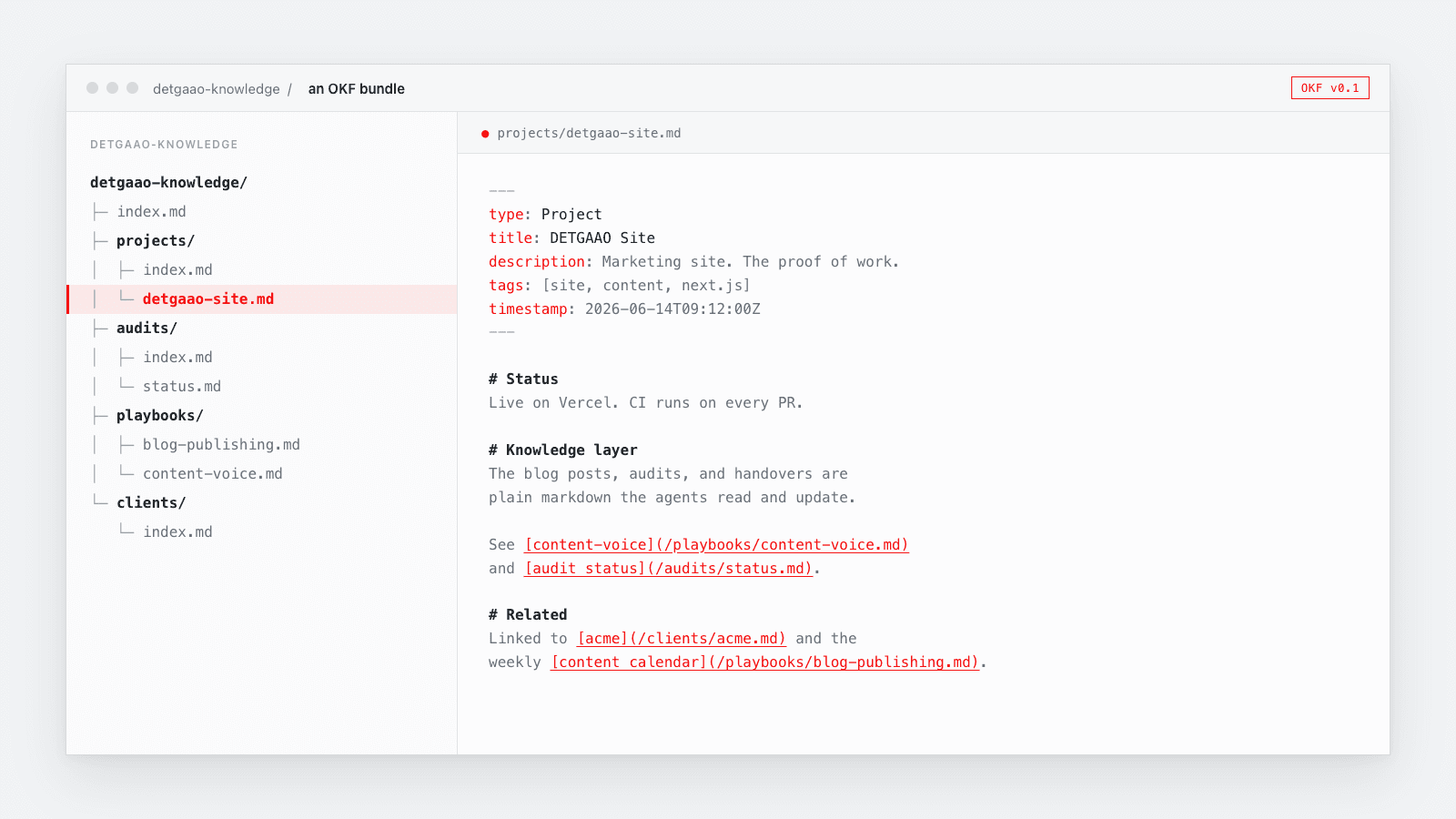
Most of what runs my work is a folder of text files. Plain markdown, nothing fancy. Notes on each project, a running status file that says where things stand, an audit file a build agent reads before it's allowed to ship anything. The tools read those files before they act and write back to them after. Somewhere in the last year I started talking to my own software through documents more than through chat windows, and I never decided to do it. It piled up one file at a time, because it worked.
I figured this was just a me thing, the kind of habit you don't bring up because it sounds like hoarding. Then last week Google published a spec that describes the exact setup, gave it a name, and stuck a version number on it.
So it has a name
It's the Open Knowledge Format, OKF for short, and the whole thing fits in a sentence. A folder of markdown files, each one describing a single thing (a table, a metric, a process, whatever you need to write down), a few structured fields at the top, and plain links between the files so the folder reads like a little wiki. That's it. No database, no API key, no account. If you can write a text file, you can write OKF.
What matters is what the agent does with it. Instead of searching the same scattered docs every time it needs context, it reads a folder that grows as you go, and it can update the files itself. The knowledge builds up instead of getting reassembled from nothing on every request. Andrej Karpathy described this pattern a while back and put it better than I will: the bookkeeping that makes people give up on their personal wikis, all the cross-referencing and tidying, is exactly what a model is good at. It doesn't get bored. So you let it keep the notes.
Google Cloud shipped OKF on June 12. Version 0.1.
What it isn't
Here's where I think most people are about to go wrong. Google, plus AI, plus open, and every marketer reaches for the SEO playbook. They'll assume OKF is a new file you bolt onto your website so the AI engines rank you or quote you. It's not. OKF came out of Google's data team. It's about feeding your own knowledge to your own agents inside your own systems. It has nothing to do with whether ChatGPT or Google's AI answers ever mention your business.
We've seen this one before. llms.txt did the rounds not long ago, a little file you'd drop on your site to feed the language models. Everyone added it. Then Google said flatly that it does nothing for search. OKF sits even further from an SEO trick than that did. If someone tells you adding OKF will get you into AI Overviews, they haven't read it. Don't put it on your marketing site expecting something to happen, because nothing will.
Where it matters
It matters at the knowledge layer, the part of AI work nobody puts on a slide. Everyone rents the same models. You and your competitor can buy the same frontier model this afternoon, so the model was never going to be your edge. The edge is whether your knowledge is in a shape the machine can use.
Mostly it isn't. It's smeared across a CRM, a wiki nobody updates, a shared drive, a few Slack threads, and the head of the one person who knows how the billing logic works. Point an agent at that and it rebuilds the same answer from scratch every time, wrong in a new way on each pass. OKF is one fix for the mess: put the knowledge in plain files the agent can read, and the next agent, and the one after that, with no custom integration for each. I've run a homemade version of this for a while. The audits I keep mentioning are part of it, a set of files a build agent checks before it touches anything. Mine was held together with tape. A real standard underneath it is an upgrade I'll take.
Now the caveat. OKF is two days old. It's version 0.1, and Google calls it a starting point, not a finished standard. Every example in the announcement is a database table, which tells you which room it was born in. Don't rebuild your operation around it this week. Hold onto the pattern, not the version number: plain files, readable by people and machines, that your agents read and keep current. That predates OKF and will outlive whatever OKF becomes.
Legible wins
This was always going to get standardized, because it works and because it leans on exactly what the machines are good at. The companies that pull ahead in the next stretch won't be the ones with a better model than you. They'll be the ones whose knowledge the model can read.
My folder of markdown was never clever. It's legible, to me and to the tools I hand the work to, and that turns out to be most of the game. I've spent a year writing documentation for an audience of robots and feeling a little weird about it. Now it's got a spec number. I'll take the validation.
Frequently asked questions
- What is the Open Knowledge Format?
- It is a specification Google Cloud published on 12 June 2026, at version 0.1, for storing knowledge as a folder of markdown files. Each file describes a single thing, a table, a metric, a process, with a few structured fields at the top and plain links between the files, so the folder reads like a little wiki. There is no database, no API key and no account. If you can write a text file, you can write OKF.
- Does adding OKF to your website help you rank or get quoted by AI?
- No. OKF came out of Google's data team and is about feeding your own knowledge to your own agents inside your own systems. It has nothing to do with whether ChatGPT or Google's AI answers ever mention your business. The same mistake was made with llms.txt, a file everyone added to their site before Google said flatly that it does nothing for search. Anyone promising that OKF will get you into AI Overviews has not read it.
- Why keep knowledge in plain files instead of the tools you already have?
- Because the knowledge builds up instead of getting reassembled from nothing on every request. An agent reads a folder that grows as you go and can update the files itself, rather than searching the same scattered docs each time it needs context. Most company knowledge is smeared across a CRM, a wiki nobody updates, a shared drive, a few Slack threads and one person's head. Point an agent at that and it rebuilds the same answer from scratch, wrong in a new way on each pass.
- Should you rebuild your knowledge systems around OKF now?
- Not this week. OKF is version 0.1, published days before this was written, and Google calls it a starting point rather than a finished standard. Every example in the announcement is a database table, which tells you which room it was born in. Hold onto the pattern rather than the version number: plain files, readable by people and machines, that your agents read and keep current. That predates OKF and will outlive whatever OKF becomes.
Signal, by email
One email when there is a new piece. No sequence, no digest, no drip campaign.
Prefer a reader? Signal has an RSS feed
Google lets you choose which sources it shows you more of. Mark DETGAAO as a preferred source and Signal moves up in your search results, not everyone's.
Add as preferred sourceOne click, and reversible in your Google settings.
Want help thinking through what this changes for your marketing operations?
Start a conversation